

Outdoor pickleball introduces variables that indoor players may not encounter to the same degree. Wind, temperature and hard court surfaces can all influence rallies. This makes the construction of 40 holes balls an important subject for players who want to understand why outdoor pickleballs behave the way they do.
Rather than treating hole count as a marketing specification, it is useful to understand its practical effect on play.
Why Pickleballs Have Holes
The holes in a pickleball influence airflow around the ball while it travels.
Unlike a solid rubber ball, a perforated pickleball loses speed and reacts to air resistance in a distinctive way. This helps create the characteristic pace and trajectory of the sport.
Hole size and arrangement vary between ball designs, which is one reason different balls can feel noticeably different despite appearing similar.
Why 40-Hole Designs Are Common Outdoors
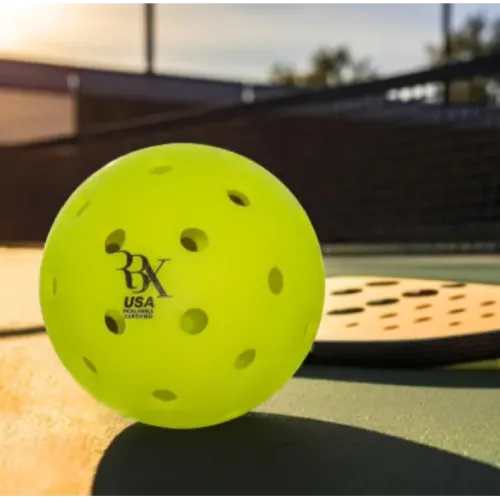
Outdoor pickleballs frequently use 40 relatively small holes.
The configuration is designed for the demands of outdoor play, where wind resistance and hard surfaces affect the game. Players may notice a faster, firmer response compared with some indoor ball designs.
The practical difference becomes clearer during serves, drives and fast exchanges.
A consistent outdoor ball helps players judge depth and pace with greater confidence.
Wind Changes Ball Behaviour
Wind is one of the biggest challenges in outdoor pickleball.
A headwind can slow the ball and affect depth. A tailwind can carry shots farther than expected. Crosswinds can influence lateral movement.
Experienced outdoor players adapt by adjusting:
- Swing speed
- Shot height
- Target margin
- Spin
- Court positioning
Using a suitable outdoor ball cannot eliminate wind, but predictable equipment makes adaptation easier.
Temperature Can Affect Performance
Delhi experiences significant seasonal temperature variation. Players using outdoor courts may encounter very hot summer sessions as well as much cooler winter conditions.
Plastic reacts to temperature.
Depending on its formulation and construction, a ball may feel harder or softer under different conditions. Durability can also vary.
This is one reason clubs and regular players should avoid judging a ball exclusively from a single session.
Roundness Is More Important Than It Looks
A distorted ball can create unpredictable bounces and irregular flight.
Before a serious game, place questionable balls on a flat surface and visually inspect their shape. During warm-up, pay attention to unusual bounce behaviour.
For casual play, a slightly worn ball may remain usable. For structured training, however, consistency becomes more important because athletes are trying to repeat movements accurately.
Training With Consistent Balls
Coaches often design drills around repetition. A player may practise dozens of third-shot drops, cross-court dinks or returns during one session.
If balls behave differently from one repetition to another, it becomes harder to identify whether an error came from technique or equipment.
For this reason, academies can benefit from grouping balls of similar type and condition during training.
Choosing Outdoor Balls in Delhi
Players shopping for outdoor pickleball balls in Delhi should consider more than quantity.
Useful factors include:
- Intended recreational or competitive use
- Ball construction
- Durability
- Consistency between balls
- Playing temperature
- Court surface
- Approval requirements where applicable
Brand familiarity can help narrow the options, but performance suitability should remain the priority.
RBXSports works within Delhi's growing pickleball equipment market, serving players and sports buyers looking for paddles, balls and related equipment. For ball selection, understanding the playing environment is often more useful than choosing purely according to price.
When Should a Ball Be Replaced?
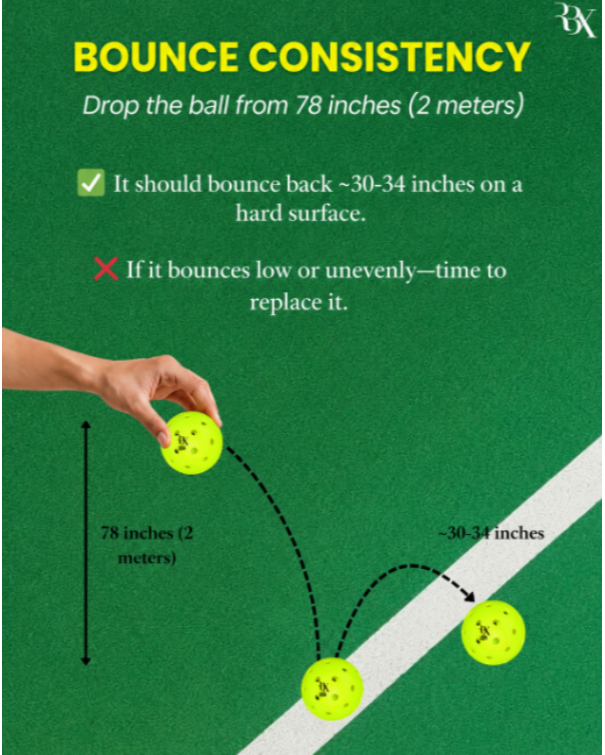
Replacement may be appropriate when a ball develops a crack, becomes visibly out of round or starts bouncing inconsistently.
Players should also compare heavily used balls with a fresh ball from the same type. Gradual deterioration can be difficult to notice when the same practice stock is used continuously.
Clubs can periodically separate training balls according to condition so that better-quality stock remains available for match simulations.
Forty-hole construction is only one part of outdoor pickleball performance. Material, manufacturing consistency, condition and environmental factors all contribute to the way a ball behaves.
Understanding those variables allows players to make more informed equipment choices and adapt their technique intelligently when outdoor conditions change.